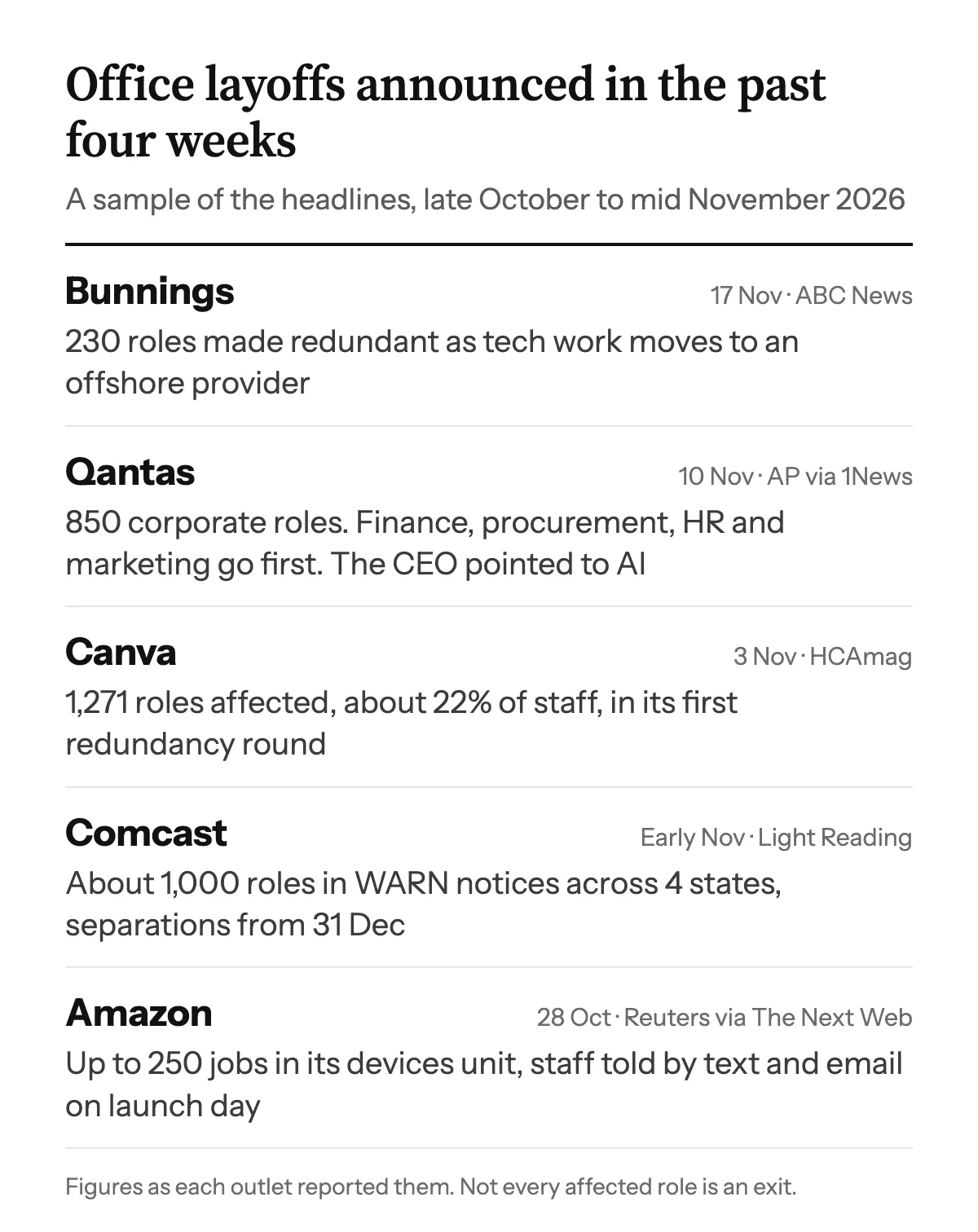
On 10 November, Qantas axed 850 office roles. Finance, HR and MARKETING go first.
None of them picked their date. Here’s how to pick yours.
No one quits a good job. The salary’s fine, the title’s fine, and every year you stay, leaving gets a little harder. Golden handcuffs.
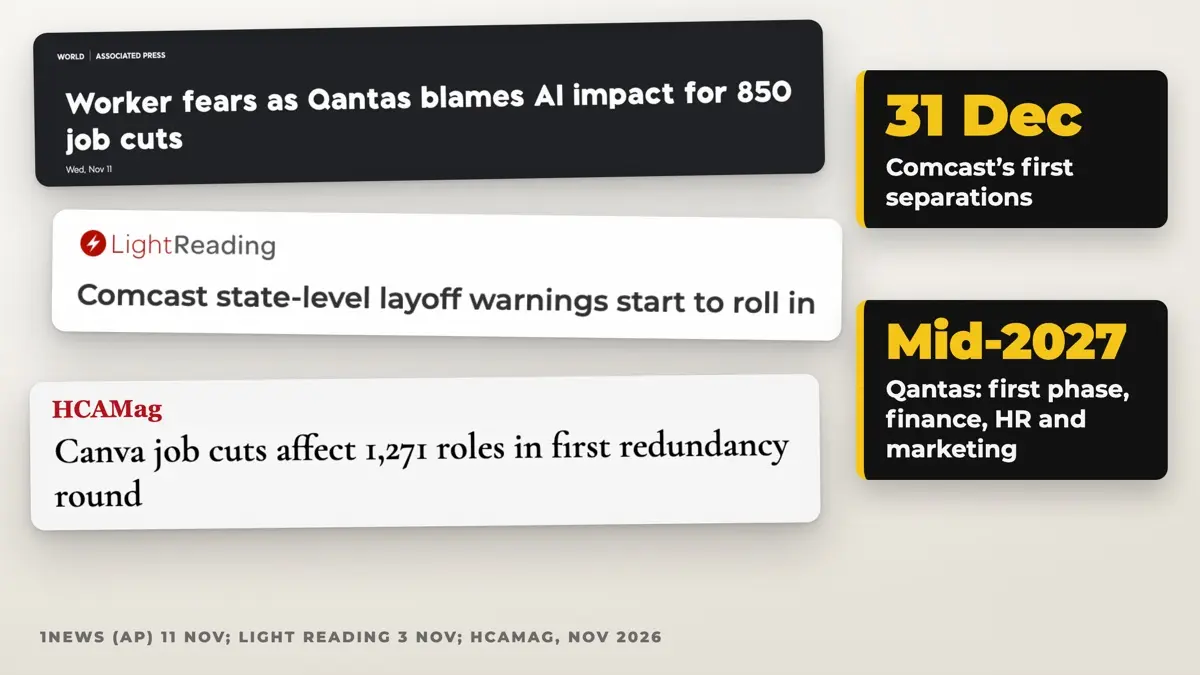
BUT: in the last 4 weeks, Qantas named 850 office roles going, Canva said about 22% of its company was affected, and Comcast set a first last day of 31 December.
None of those people chose their exit date. Someone else did, in a meeting they weren’t in.
The good news: the people who get to pick their own date started something on the side first, and kept the job while they did it.
Below I’ll break down the 2 moves, before Black Friday on 27 November.

3 employers picked the dates in 4 weeks
The Qantas email went out on a Tuesday.
On 10 November, CEO Vanessa Hudson told staff about 850 corporate roles are going. The work moves to Accenture under a multi-year outsourcing deal, and she pointed to AI on the way past. The first round lands by mid-2027, in finance, procurement, HR and marketing.
(Yes, HR. The department that wrote the “our people are our greatest asset” slide.)

Comcast’s first separations land on Thursday 31 December. And on 3 November, Canva told staff 1,271 roles were affected, about 22% of the company, in the first redundancy round it has ever run.
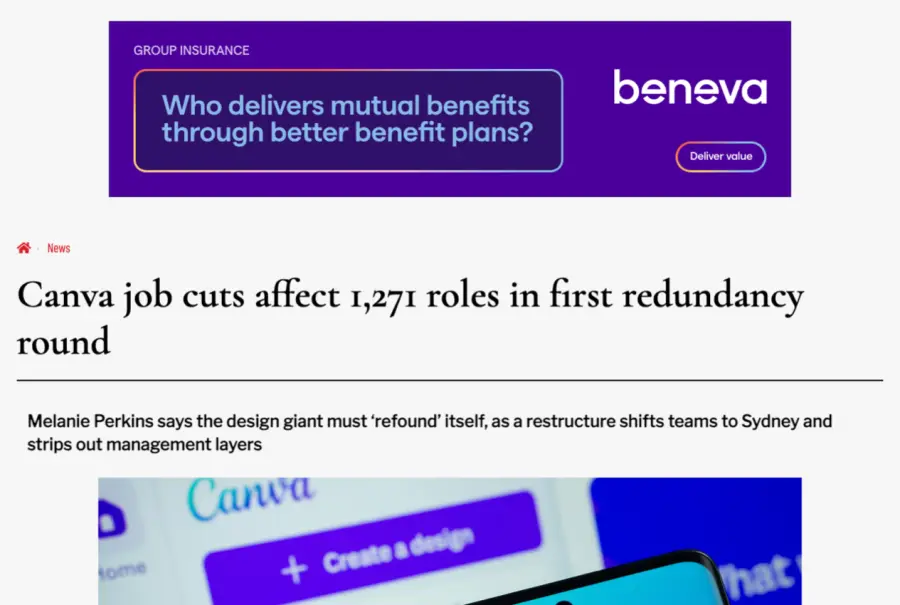
Every one of those dates was picked in a meeting the people living them weren’t in.
That’s how golden handcuffs work. The gold is real, and someone else has always had the key.
Picking your own exit date comes down to 2 moves, and you keep the day job through both.
- Move #1: Sell the work you already do for one boss to one or two brands of your own, so your income stops hanging off a single inbox.
- Move #2: Get ads you planned running on a real brand’s budget, starting with Black Friday on 27 November.
Do these 2 and the calendar starts to look different:
- the day job stops being the only door out
- a founder sees results with your name on them
- something’s already started before the next all-staff email, the way it had for the finance member below
Both moves come straight out of my programs, and more than 1,000 people have been through them.
First: why listen to me?
I’m Sean Ferres, and I teach ads.
I’ve spent almost 9 years in direct response, and 7 of them teaching marketers and copywriters how to land clients of their own. (In 2018, I was working in a warehouse. The only lanyard I owned was hi-vis.)
I also run the ads my clients write in my own ad account, with my own money, so I see every week which ads work and which people brands keep calling back.
So I get to watch both groups up close: the people waiting on someone else’s calendar, and the ones who built a way to set their own. Here’s what the second group does differently.
Move #1: Sell what you already do to more than one boss
The people who pick their own date started selling their skill outside the building first.
Evelina picked her own last day
Evelina spent 10+ years in corporate.
She was working at Dow Jones when her marriage ended, and she moved back in with her mum. So she built client income on the side, one brand and then another.
Quick note before the screenshots on this page: they’re individual stories from people who did the work. Results vary and depend on effort, and they aren’t typical outcomes.
Then, at 8:00 one morning, my phone lit up.
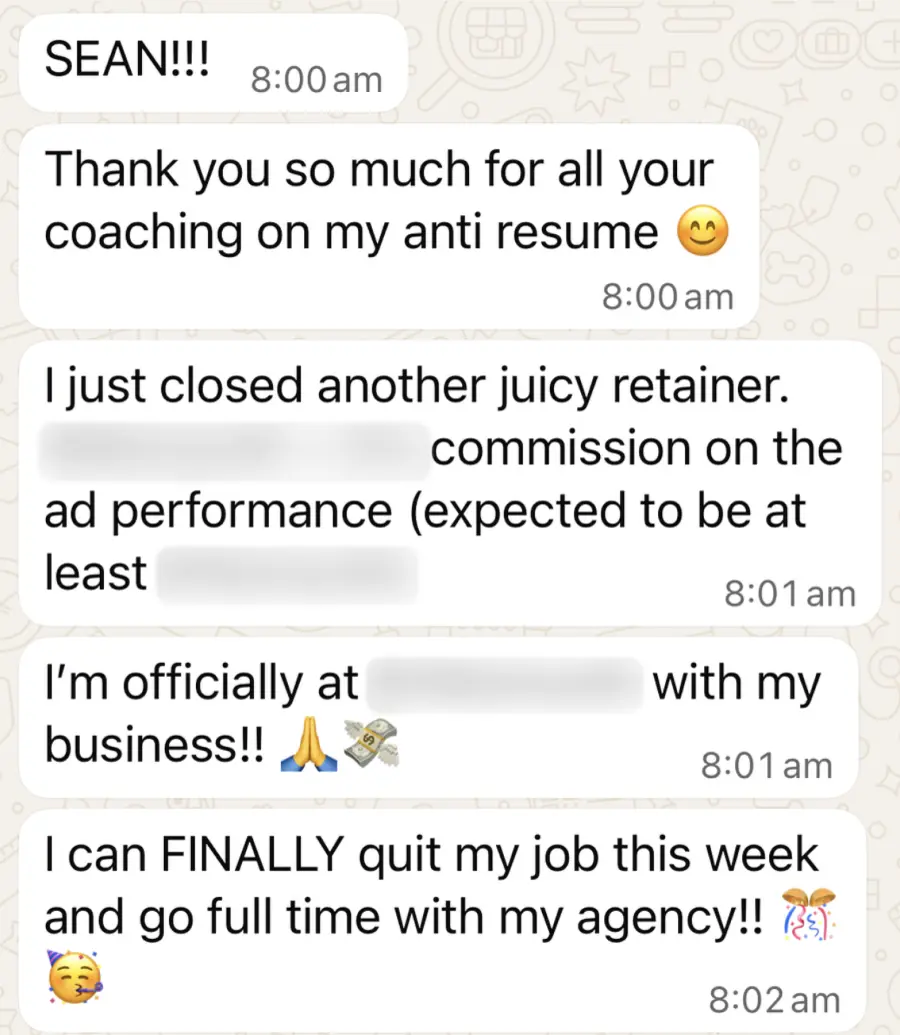
She did the work in the middle of a divorce, and the steps she took are the ones I walk through in this breakdown.
The problem: a salary buys more than your work
Most corporate people I coach like their jobs. They like the team, they’re good at the work, and Sunday arvo still turns up with a knot in the stomach.
One member had been in a well-paid finance job since uni. He summed up years of it to my team in one question:
“Do I have to go into this office again?”
Then came the 2 words: “Golden handcuffs.” He even apologised for it and called the whole thing a “first world problem”.
(Mate, apologising for wanting your own life back is the most corporate thing I’ve ever heard.)
What he wanted was simple: “I’d rather make less and have that autonomy than make more with the golden handcuffs.” Because a salary buys more than the work. It buys:
- your alarm time
- your commute
- the say over which days you’re allowed to work from your own kitchen
Cyan found the gap in that deal. He still has his day job, and he signed a DTC beauty brand as a client of his own, then typed the news into our group chat from the office, with one eye on his boss.
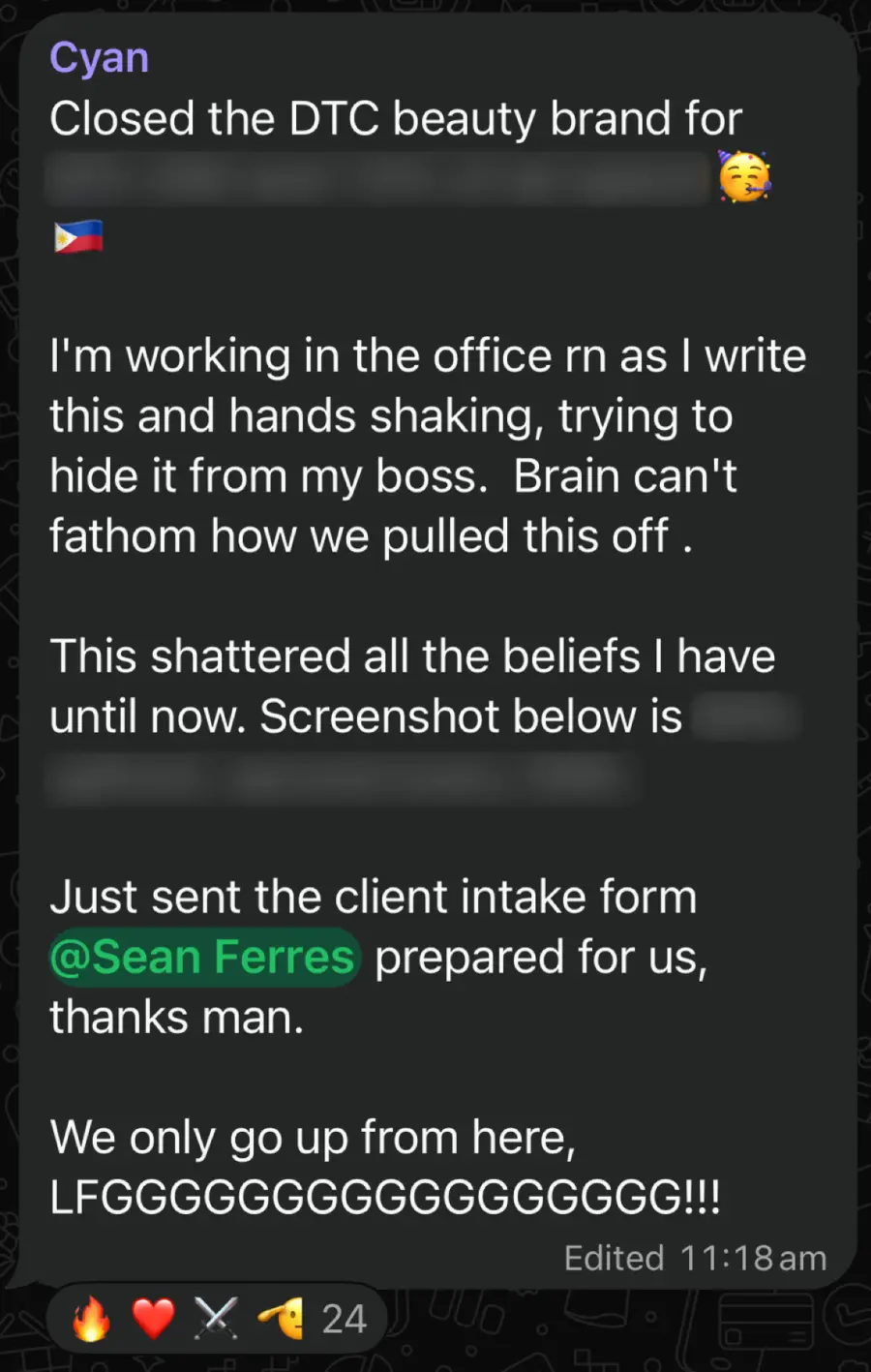
He’d started years before the email came
That finance member got out.
When a round of cuts at his employer came with a buyout offer, he took it. It only worked because of what he’d done before the announcement: for years, he’d been building on the side, closing sales calls for one business and writing copy for a couple of others.
So the all-staff email that flattens most people turned out to be his exit door, because he’d already started something.
Move #2: Get ads on a real budget before those dates land
Brands pay outside people for one skill right now, and it’s proven on real spend.
What brands pay outside people for now
Every brand on Facebook and Instagram is chasing more buyers with more ads. From what I see in the accounts I work in, the brands that scale run dozens of different ads per product, each one built for a different person scrolling on their lunch break.
AI can type all of them before your coffee’s cold. It can’t tell you which 5 will stop a dad in Ohio mid-scroll at 9pm.
The person who works that out is called a creative strategist, and brands pay them directly, the way they’d pay an agency.
They don’t take much convincing, either. When Neil put “creative strategist” in his bio, 400 opportunities landed on him and he had to change it back. (Imagine having to hide from the work. Corporate could never.)
And if you’ve spent years in a marketing job, you’ve done most of this already. You’ve sat in the budget meeting, written the brief, defended it, and watched someone senior change the headline 10 minutes before launch. The one part no corporate job teaches is getting a brand to pay you for it directly.
The 90 days when brands can’t be fussy
Black Friday is Friday 27 November, and in my experience it’s the week brands spend hardest on ads all year. Then on 1 December, every Black Friday ad goes in the bin and gets rebuilt around gifts for mum and that sister who’s impossible to shop for. By January, the gift ads are cooked, and brands need a fresh batch again.
That’s 3 rebuilds in 90 days, and the stretch when a brand cares least about your CV and most about whether you can help this week. Each one is a shot at getting your ads onto real spend, which you’ll want, because sooner or later every founder asks: “Soooo... what have your ads actually done?”
Put the 2 calendars next to each other
One calendar belongs to the employers.
- 31 December: Comcast’s first separations
- 27 January: Comcast, New Jersey
- Mid-2027: Qantas, first round
The other one is sitting wide open.
- 27 November: Black Friday
- 1 December: every brand rebuilds for Christmas gifts
- January: a fresh batch for the new year
You only get a say in one of them. And Black Friday on 27 November is the one date on either calendar you get to pick. The finance member called the window:
“This is like Bitcoin in 2010. It comes around once a decade.”
Copywriting had its moment like this, then the course gurus flooded it. I give creative strategy 3 to 6 months before the same gurus pump a flood of 18-year-olds into it. The people who start now are the ones holding proof when the crowd shows up.
The easy way to do all of this
Of course I’d love to do this with you. But whether we ever work together or not, the plan’s the same:
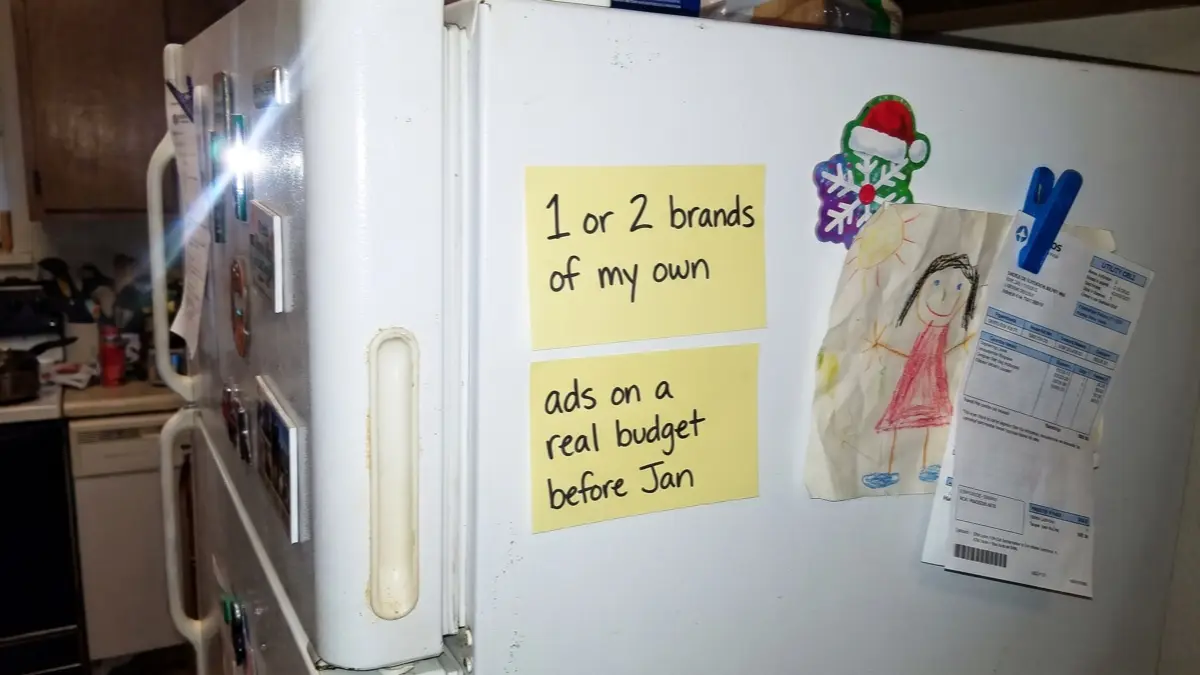
- Sell what you already do at work to one or two brands, so your income stops hanging off a single inbox.
- Get ads running on a real brand’s budget from Black Friday, while brands are rebuilding every few weeks.
Do those 2 and you’ve got a second answer ready if a date ever lands on you.
Do it yourself, or do it with us
You can jerry-rig this yourself with YouTube and a lot of trial and error. Plenty of people do.
Or you can let us do it with you. For Black Friday, I’m running a small case-study group inside The Creative Strategist Breakthrough called The Doorbusters. I’m doing it once, for Black Friday only, and 10 is the most I can take so everyone gets my eyes on their work.
Phase 1 is called “Get Useful Before Black Friday”, and it runs from now until 27 November. It’s where your research, hooks and first ads get built, so they’re ready while brands spend hardest. Join after Black Friday and Phase 1 has already happened without you. There’s no second round.
For 12 weeks, my coaches and I train you, I run 3 of your ads in my own ad account with up to $1,000 of my ad spend behind them, and Ben (a former hostage negotiator, now my closer) helps you close. Follow the steps, and if you haven’t hit the 12-week target (terms on the next page), we keep working with you for up to 9 more months at no extra cost.
It’s for people already good at a marketing, copy or sales job who can find 7 to 12 focused hours a week.
→ If you’d rather pick your own date than wait for the email, here’s how we’d set it up with you.
That’s all!
Sean
Get the next one
I write one of these when something in advertising changes and it matters for people who write, sell or market for a living. Get the next one by email.
One email when there is a new article. Unsubscribe any time. Privacy

Sean runs The Creative Strategist Breakthrough. He has spent almost 9 years in direct response and 7 of them helping copywriters land clients. 88 copywriters he has worked with have built six-figure incomes. More about Sean