“I’ll just go back to corporate.” On 5 November, that door got SMALLER.
Employers named AI in 121,401 US job cuts. New hiring is seasonal.
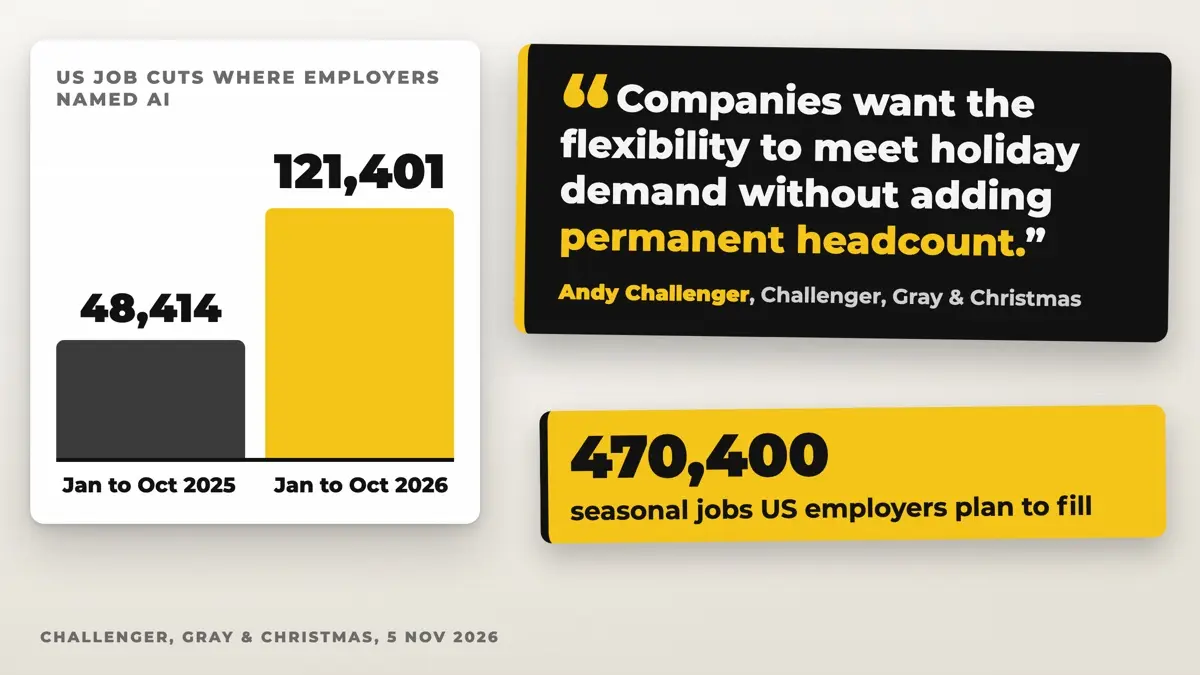
Hiring is up this season. On 5 November, Challenger counted plans for 470,400 seasonal jobs, 26% more than last year.
BUT: seasonal means the last day’s already pencilled in. Employers named AI in about 20% of the job cuts announced this year, and “they are not committing to permanent headcount.”
If “go back to corporate” is your plan B, that’s the market waiting behind the door.
The good news: there’s another door, and it opens widest the week of Black Friday, 27 November.
“I need to either make this work or go back into the corporate world,” one man told my team. Here’s what I’d tell anyone standing where he stood.

The hiring that came back has an end date on it
Challenger, Gray & Christmas counts the job cuts US employers announce each month. Its 5 November release says employers have now cited AI in 121,401 of them this year, about 20% of every cut announced.
At the same point last year, that count was 48,414.
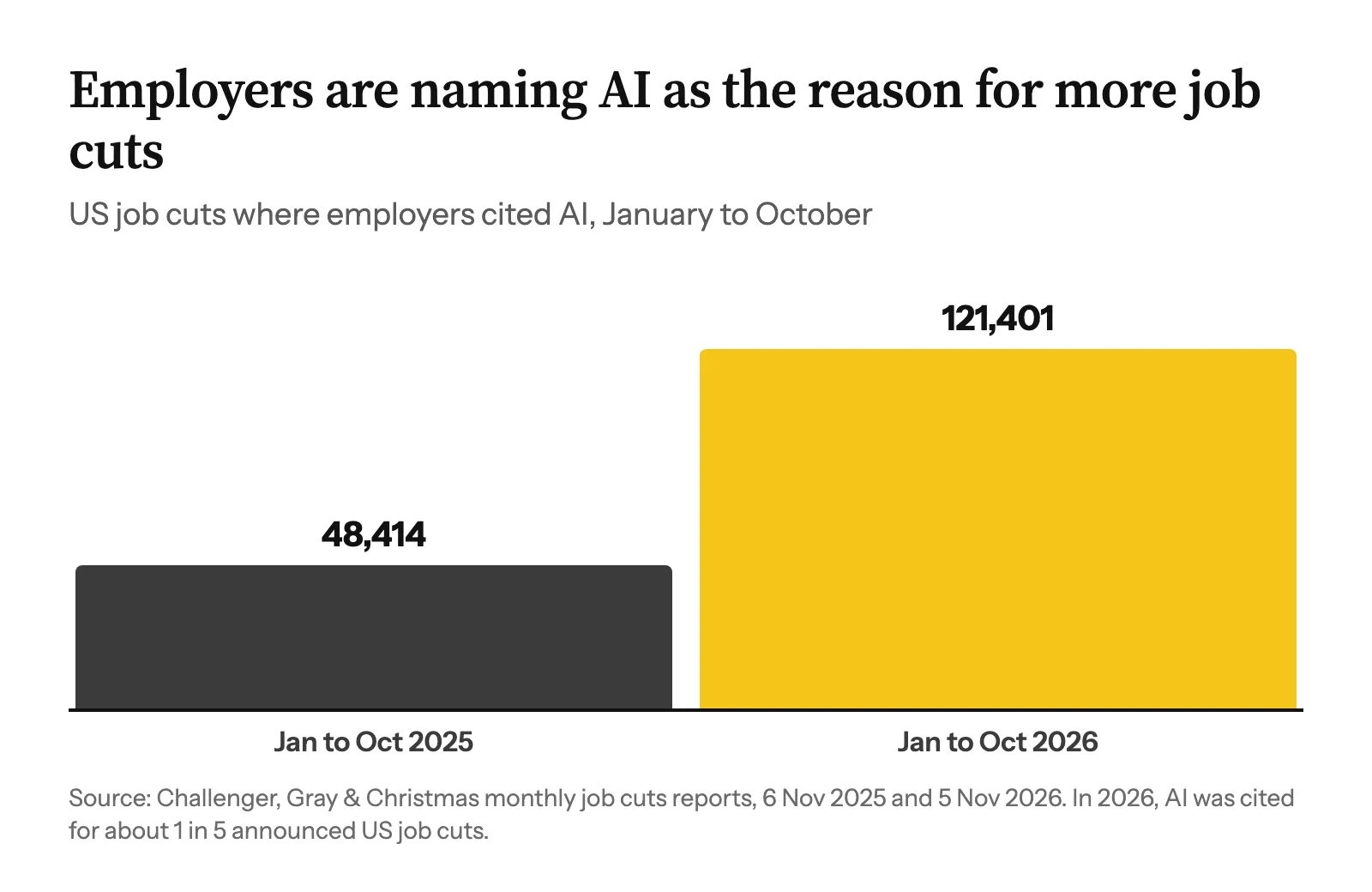
October’s overall cuts were the fewest for any October since 2023, and the government counted 165,000 jobs added. The catch is in what’s being added: plans for 470,400 seasonal jobs, up 26% on last year, with Amazon planning 300,000 of them.
The release put it plainly:
“They are not cutting deeply, but they are not committing to permanent headcount, either.”
A seasonal job comes with its last day already pencilled in. That’s fine news for the economy, and rough news if a permanent desk was the plan B.
Whether a fresh start sticks or fizzles out by February usually comes down to 2 moves, made in this order:
- Move #1: Get proof on real ad spend before you have a client.
- Move #2: Follow one roadmap, in order, with someone who can actually teach it.
Do these 2 and the fresh start changes shape:
- the founder’s first question finally has an answer
- the money stops going on courses you weren’t ready for
- every week has one next step, and someone checking it
Both moves come straight out of my programs, and more than 1,000 people have been through them.
First: why listen to me?
I’m Sean Ferres, for the record.
I’ve spent almost 9 years in direct response, and 7 of them teaching copywriters, marketers and sales pros how to land clients. (Toots horn. Checks no one’s watching. Toots again.)
I also run the ads of the people I coach in my own ad account, with my own money behind them. Yes, on purpose. You’ll see why in a minute.
So I get a front-row seat to who makes a fresh start stick, and who’s back refreshing job boards by March. Talent rarely separates them. Those 2 moves do.
Move #1: Get proof before you pitch anyone
The man at the top of this page needed proof before he needed a single client.
He’d spent years in cybersecurity sales, and his job had gone a year before he spoke to my team. By then, he was down to one sentence: “I need to either make this work or go back into the corporate world.”
When my team asked him what success looked like, there wasn’t a boat in his answer. He said: “Replace the income from my IT job.”
He wanted his old Tuesday back, with his own name on the invoice. And the report above describes the market sitting behind his plan B.

The problem: spec work no one opens
He asked my team a question I’ve watched courses dodge for years:
“How do you get proof without clients, when clients want proof?”
Most courses answer it with 2 words: “spec work.” So you make ads for a brand that never asked, drop them in a Google Drive folder and send the link to founders who never click it. (Founders open spec-ad folders about as often as they read the terms and conditions.)
Then the one founder who does reply asks: “Soooo... what have your ads actually done?”
No proof means no client, and no client means no proof. I call it the beginner death spiral, and every lap of it burns another month.
The fix is a bit unhinged
The people I coach make 3 ads for one of my live funnels, and I run them in my own ad account with up to $1,000 of my ad spend behind them. If the ads work, the screenshots are theirs.
Quick note before the screenshots on this page: they’re individual stories from people who did the work. Results vary and depend on effort, and they aren’t typical outcomes.
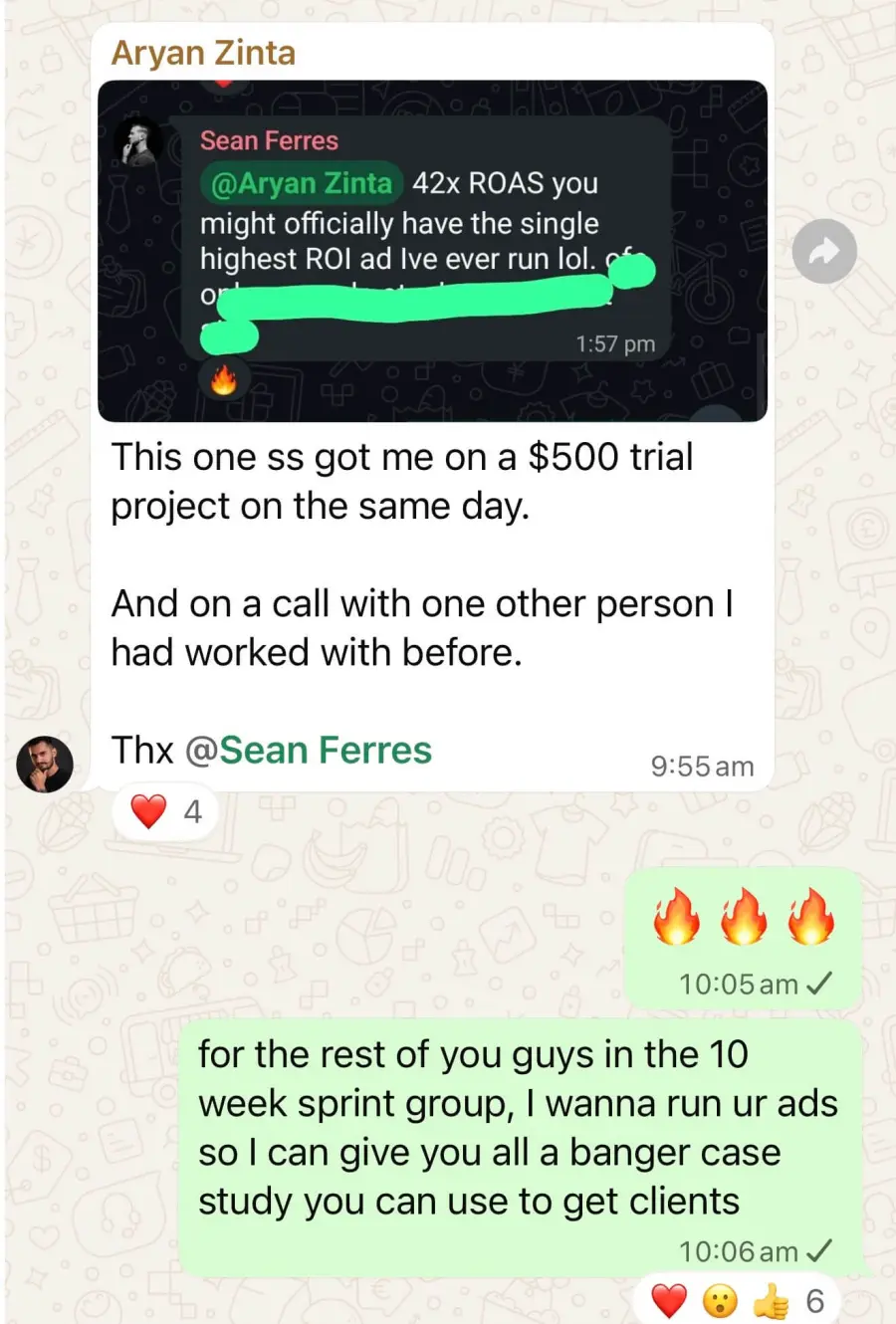
Aryan’s worked, at a 42x return on ad spend. I sent him the screenshot, he sent it to a founder, and he had a paid trial the same day.
Whatever you do next, get proof on real ad spend before you pitch anyone. If you want to see exactly how we do it, the full breakdown is here.
Black Friday is why the door’s open this month
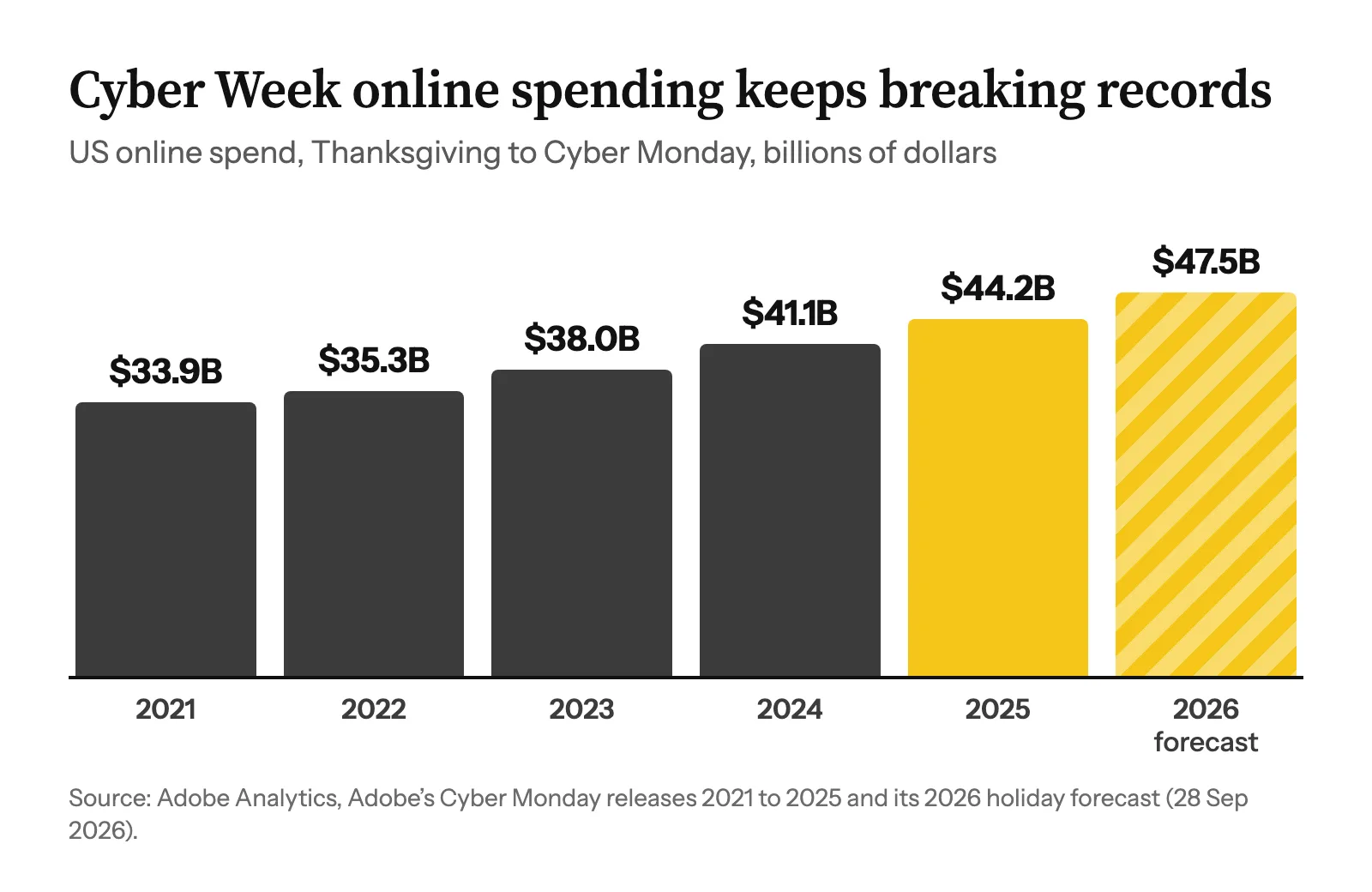
Black Friday lands on the 27th. Adobe expects Americans to spend $47.5 billion online across Cyber Week, and every one of those dollars has an ad chasing it.
Then on 1 December, shoppers stop buying for themselves and start buying for their mum, and the Black Friday ads go in the bin. By January, the gift ads are toast too, which makes 3 full rebuilds in about 90 days.
Dave from marketing can’t pull an extra 300 ads out of thin air on his lunch break. More ads being tested means more chances for a newcomer’s ad to get real money behind it, and that’s the proof you’re after.
Move #2: Follow one roadmap, and stop buying new ones
One order, followed to the end, beats a drawer full of courses.
Back to our man in sales. On everything he bought in the year after his job went:
“I bought a lot of stuff I wasn’t ready for.”
That’s the polite way to describe a course graveyard. There’s the scaling course bought with nothing to scale yet, and the copywriting course that teaches gorgeous sentences, then leaves “now go get clients” on the last slide like a fortune cookie.
On the program before ours: “The coach could do the work, but he couldn’t teach other people how to do it.” If you’ve ever asked a natural footy player how they kick a 50-metre goal, you know this one. The answer is always “Dunno mate, you just... kick it.”
And on the calls that came with it: “30 hours a week on Zoom calls that were really pointless.”
(Somewhere in breakout room 4, a vision board is still being workshopped.)
The success stories that sold him on that program didn’t survive a closer look either. His words: “The students getting wins said they’d have gotten them anyway.”
The fix is boring on purpose
It starts with one week. Here’s the first 7 days I hand anyone starting from zero:
- Day 1: pick one market
- Day 2: find 3 brands in it already spending on ads
- Day 3: tag their ads, so you know who each one is for and what it promises
- Day 4: find the ad they’re missing
- Days 5 to 7: make it
By day 7, you’re holding the thing that gets a founder to reply: the ad their brand is missing, already made, with a reason it should exist.
From there, the people I coach follow one order for 12 weeks. They plan and produce in weeks 1 to 3, get proof in my ad account in weeks 4 to 7, then lock in retainers in weeks 8 to 12. You post your action steps every week, so going quiet gets noticed.
What it looks like when the order does the work
Siz writes short video scripts for brands. This landed in our wins chat 3 months after joining us.
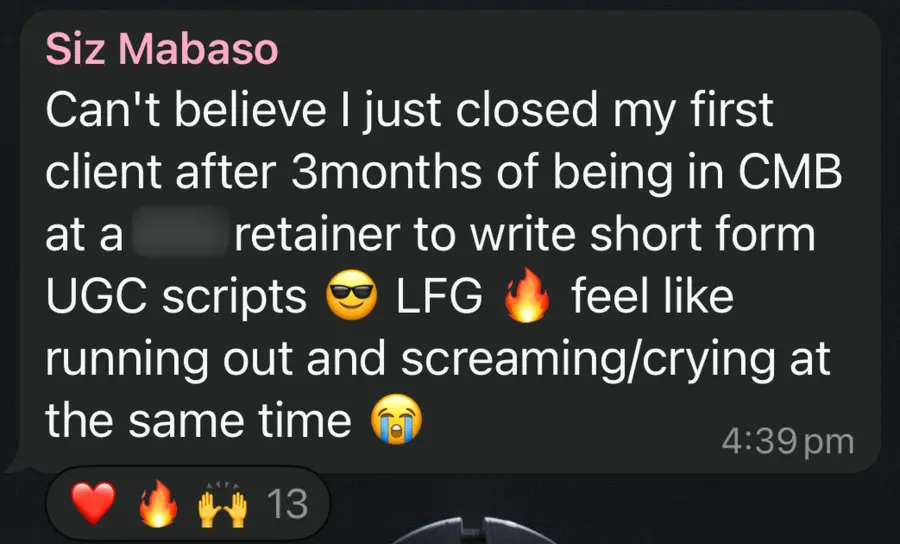
Siz took 3 months, and plenty of people take longer. If you want the 12 weeks laid out, the roadmap is here.
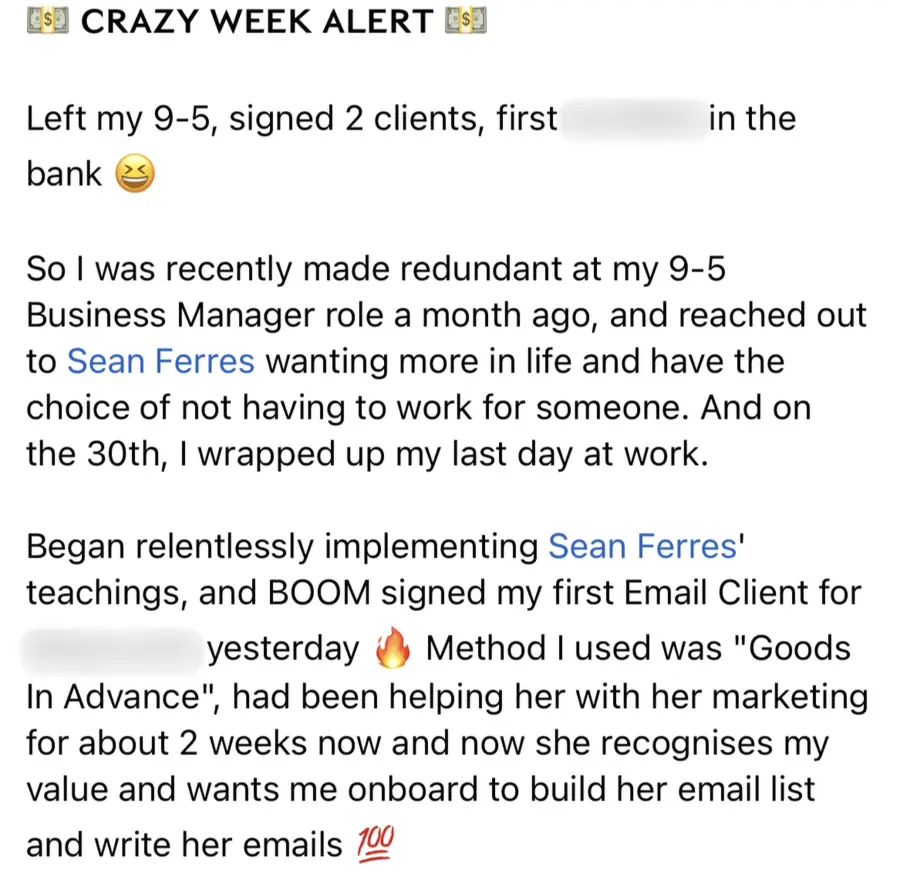
Ray Pang came at it from a layoff. He was called into a one-on-one on an ordinary working day in 2019 and walked out without a job. A month later, he posted this.
The easy way to do all of this
Of course I’d love you to do this with me. But whether you work with me or not, if you’re at that fork this year, you must:
- Get proof on real ad spend before you pitch
- Follow one roadmap in order, with someone checking your work
Do those 2 and the fresh start has proof and a plan behind it before anyone asks for either.
Do it yourself, or do it with us
You can jerry-rig all of it yourself with YouTube and a lot of trial and error. Plenty of people do, and a few of them even enjoy it.
If you’d like the shortcut, it’s called The Doorbusters: a 12-week case-study group inside The Creative Strategist Breakthrough, built around Black Friday, Christmas and the January refresh. I’m doing it once, for Black Friday only, and 10 is the most I can take so everyone gets my eyes on their work.
Phase 1 is called “Get Useful Before Black Friday”. It’s weeks 1 to 3 of that roadmap, and it runs from now until 27 November. Join after Black Friday and you start the 12 weeks with the first 3 already gone. There’s no second round.
My coaches and I train you, and I run your ads in my account. Follow the steps, and if you haven’t hit the 12-week target (terms on the next page), my team keeps working with you for up to 9 more months at no extra cost.
It’s a bad fit if you want something hands-off. If you can free up 7 to 12 focused hours a week, it might be a good one.
→ If you’d like the 12 weeks set up with you before Black Friday, here’s how we’d do it
That’s all!
Sean
Get the next one
I write one of these when something in advertising changes and it matters for people who write, sell or market for a living. Get the next one by email.
One email when there is a new article. Unsubscribe any time. Privacy

Sean runs The Creative Strategist Breakthrough. He has spent almost 9 years in direct response and 7 of them helping copywriters land clients. 88 copywriters he has worked with have built six-figure incomes. More about Sean